
Pinned down and terrified
Beak Guard Fitting: The Procedure The Industry Doesn't Want You To See

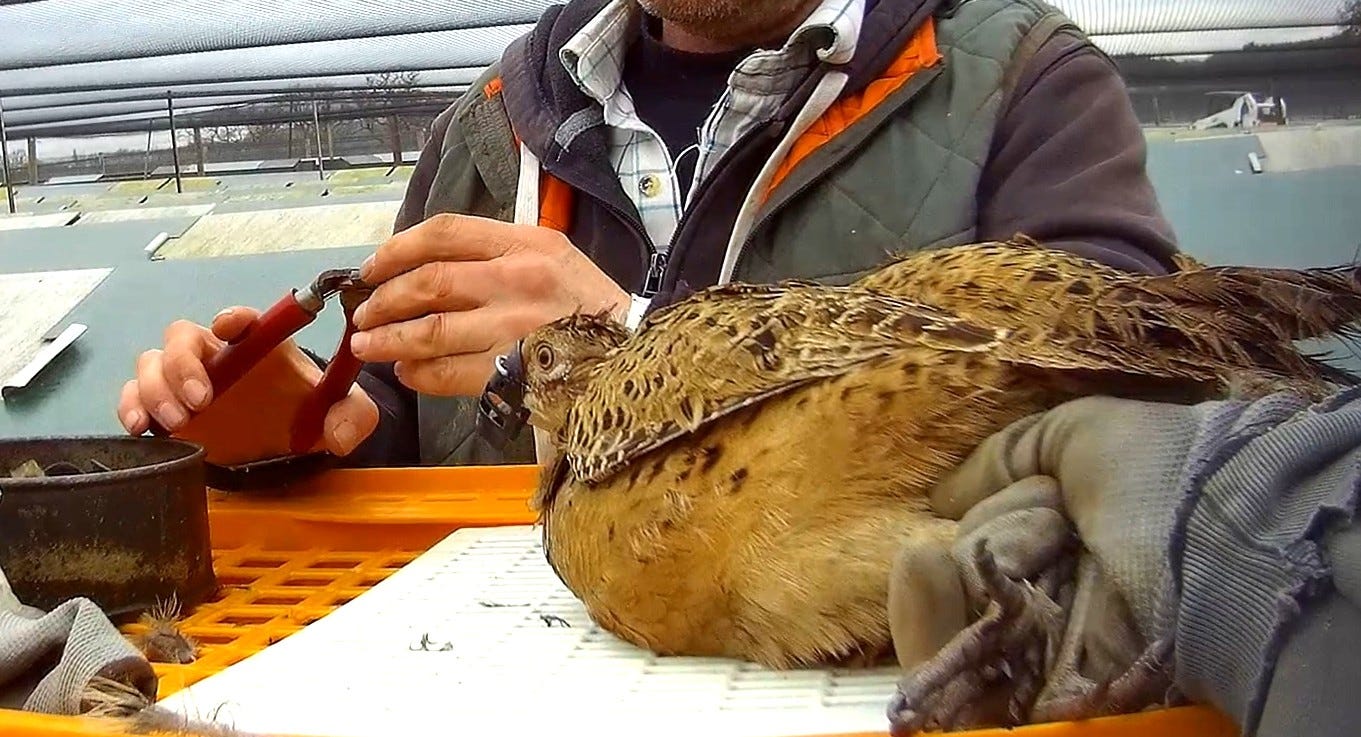
Imagine you’re a bird. You’re already living in a stressed state, trapped in a cage. Nowhere to go.
Suddenly, humans surround you. You’re grabbed, hung upside down, and carried off. You’re pinned down, your head is yanked forward, and something is fitted to your beak - a highly sensitive structure that contains a complex network of nerves, blood vessels, and specialised sensory receptors.
Imagine the terror. The shock. The stress.
THAT is the process that millions of birds undergo because the shooting industry keeps them in cages.
Beak Guards
Beak guards and ‘spectacles’ - plastic or metal devices clipped to the upper mandible of pheasants bred for the gun - are designed to stop feather pecking, cannibalism, and injuries caused by the aggression of birds trapped in stressful conditions.
They are not supposed to be fitted as a matter of routine. The government’s ‘Code of practice for the welfare of gamebirds reared for sporting purposes’ says the following (the highlighting is ours):
5.1 The use of management devices or practices that do not allow birds to fully express their range of normal behaviours should not be considered as routine and keepers should work towards the ideal of management systems that do not require these devices. Such devices and practices include mutilations such as beak trimming…and the use of bits, spectacles and hoods to prevent feather pecking, egg eating or aggression.
Previous articles from our undercover investigation have already provided evidence that at Heart Of England Ltd, one of the largest suppliers of birds for the gun in the UK, the fitting of these ‘guards’ IS ROUTINE (see ‘Fix the Bird Not The Conditions’).
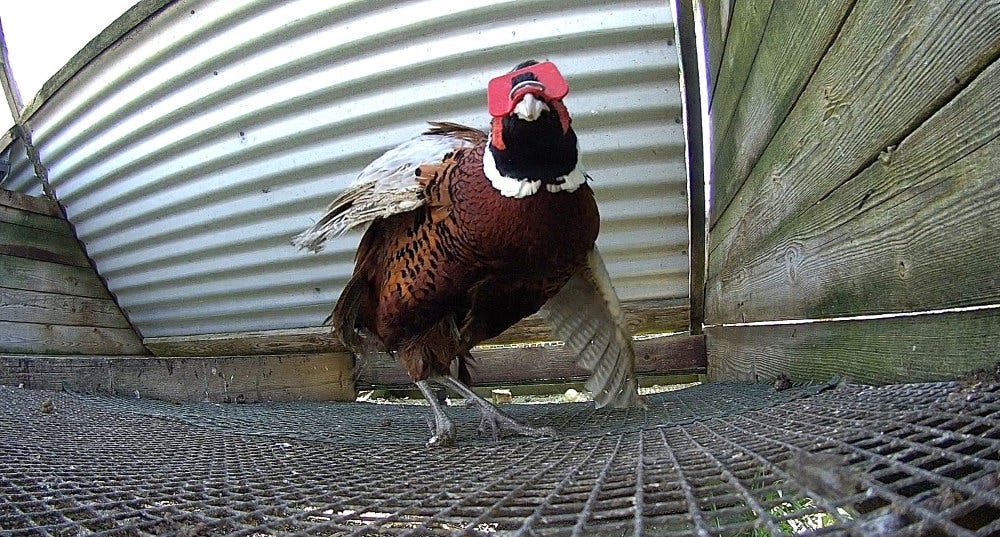
In video after video, image after image, most birds are wearing spectacles (male pheasants) or ‘beak guards’ (females).
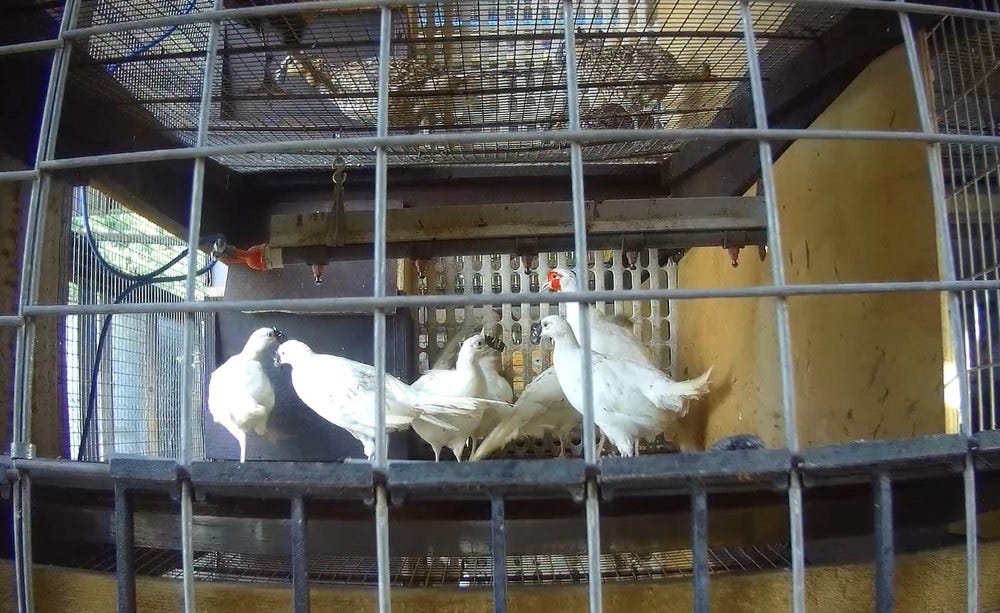
Caught and Pinned
But how are these horrible things fitted? What does the fitting process (‘bitting’) actually involve?
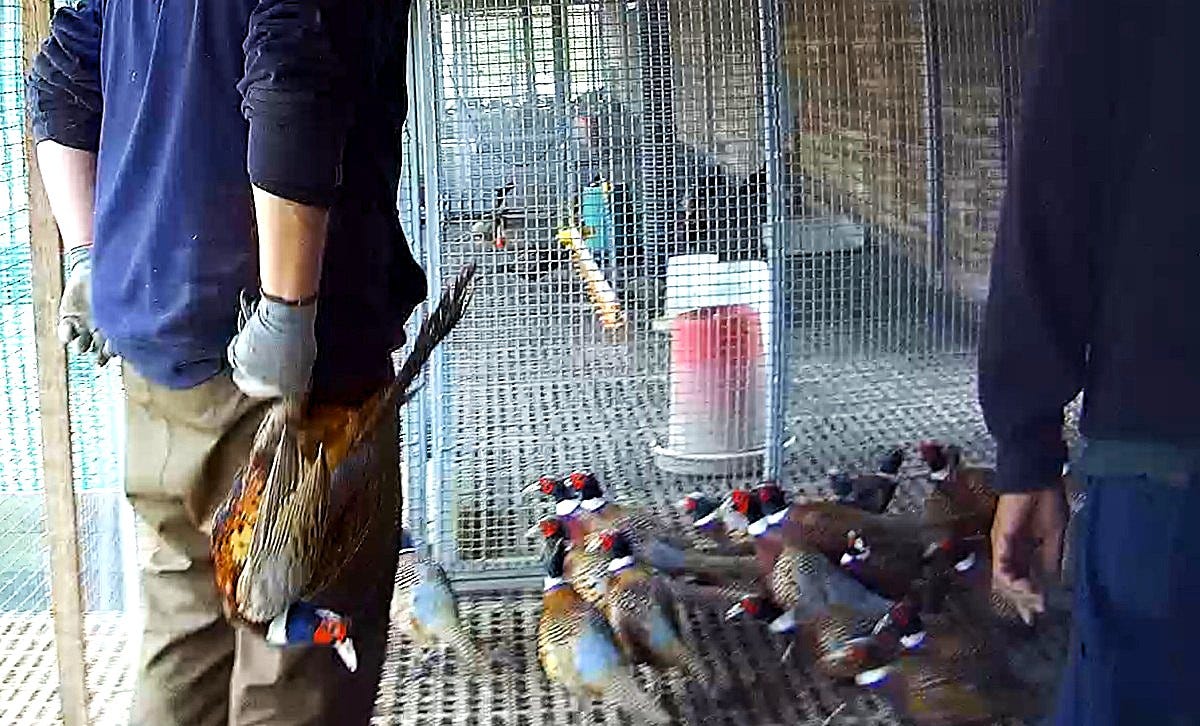
We’ve already explained that the procedure begins with catching-up (see Chaos in the Cages). Workers ‘catch up’ the birds, grip pheasants by the legs and bunch them together, hanging them upside-down like they’re carrying a bag by the handles...
For a bird hardwired by evolution to flee at the first sign of threat, being seized, inverted and held immobile is by any reasonable measure, a moment of acute fear.
The bunches of birds are then brought to a table or, where no table is available, an upturned crate. Each bird in turn is held down - body pinned, head controlled - while the ‘specs’ or beak guard is fitted. The device is clipped or pushed onto the upper beak, blunting the bird’s ability to see forward and/or to peck effectively.
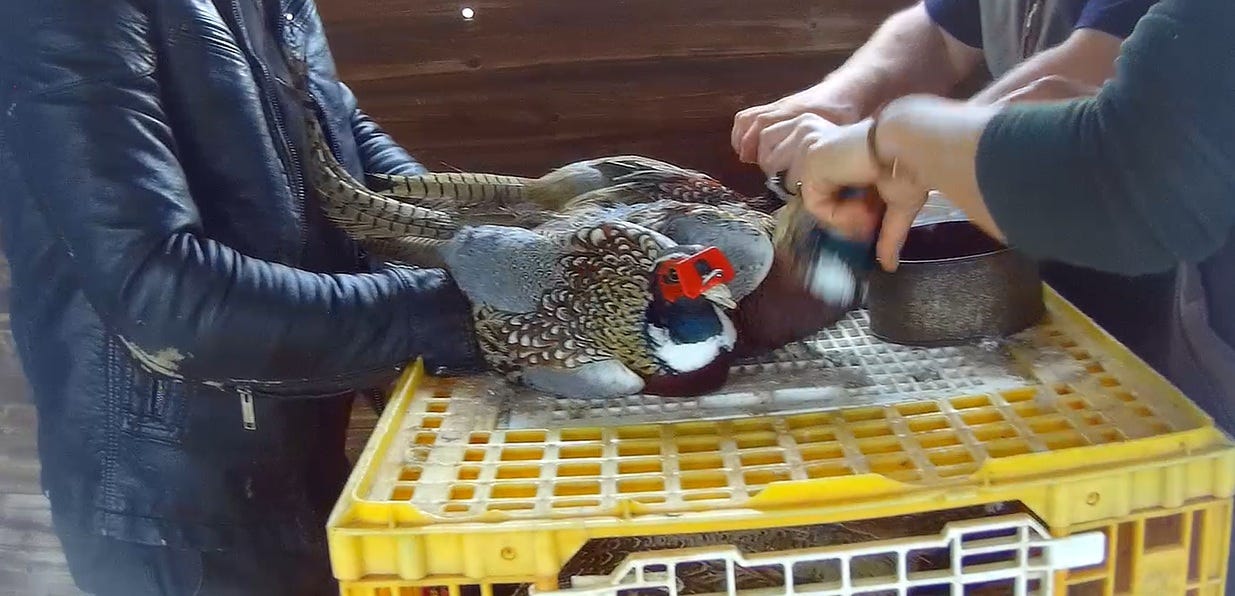
The whole operation is repeated, bird after bird, pen after pen. Routinely.
Terrified and Mutilated
A pheasant - male or female - held down on a table, body pinned, is terrified.
The signs are unmistakable to anyone who knows what they are looking at. The beak opens and the bird pants - a rapid, shallow breathing that has nothing to do with exertion and everything to do with fear. The eyes are wide and fixed, the stare of a prey animal that has run out of options.
In some birds, the throat visibly flutters - gular flapping, the same mechanism a dog uses to cool itself, triggered here not by heat but by acute physiological stress.
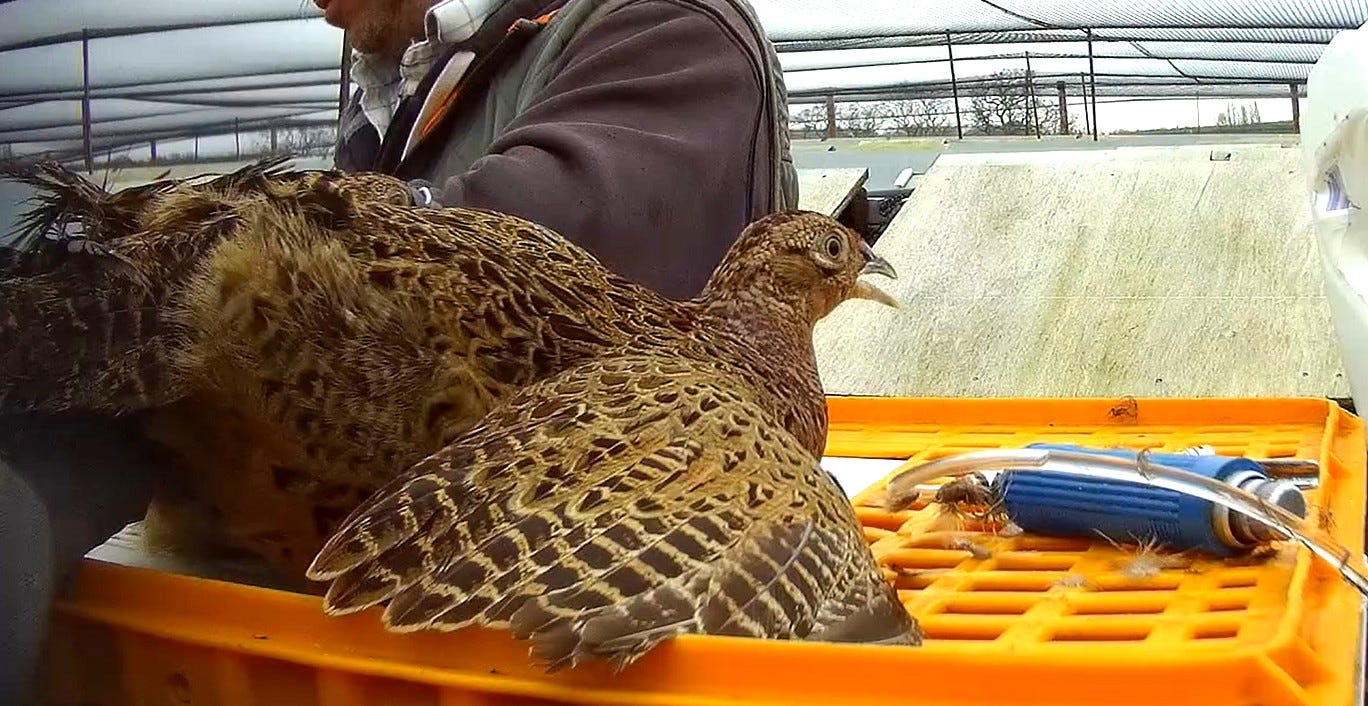
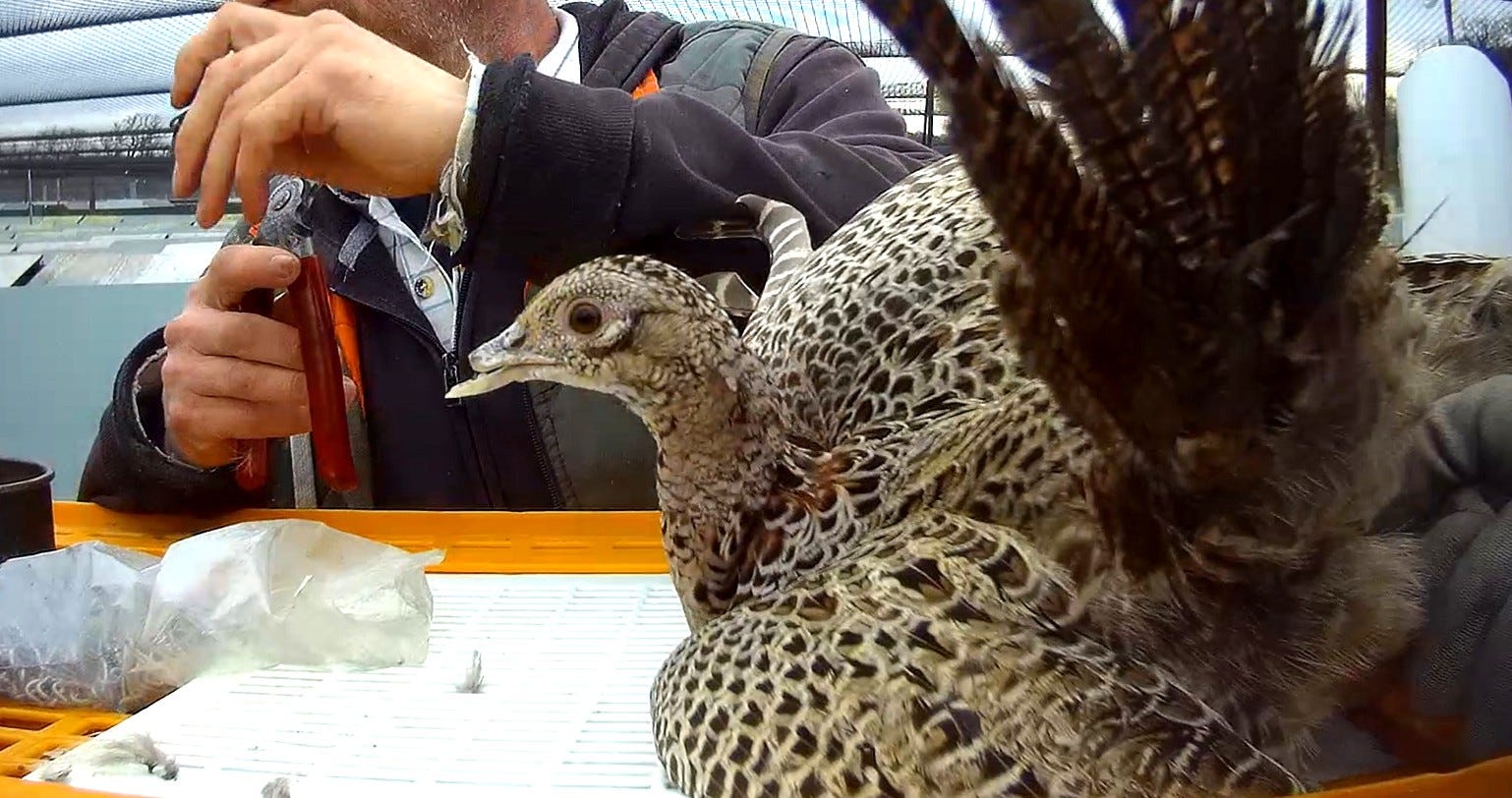
Note also that the beaks of the birds in the images and the video have ALREADY been mutilated! The upper mandibles have been trimmed.
This is done between 3 to 6 weeks of age to prevent fatal feather pecking and cannibalism - which frequently break out when high numbers of birds are reared together in enclosed spaces. Exactly the factory farm conditions that the profit-driven shooting industry keeps millions of birds in. And then - to add insult to literal injury - it fits the same birds with a device to stop them from closing what is left of their beaks!
This is what the shooting industry’s careful branding never shows you.
The glossy imagery of driven shoots - birds rising from cover crops, the language of conservation and countryside stewardship, the insistence that these are wild creatures living something close to a natural life - depends entirely on your not picturing this table, these hands, these eyes. These mutilations.
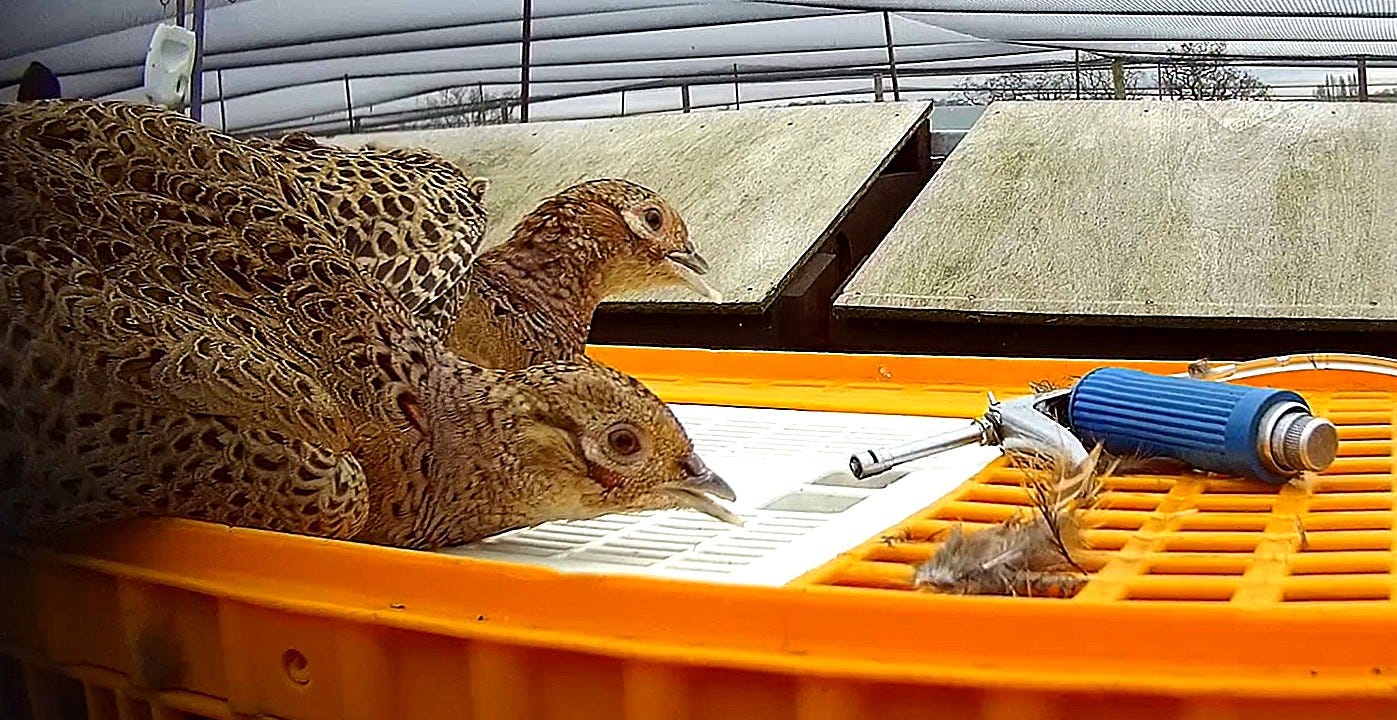
This is the absurdity of the pheasant shooting industry’s position. Birds killed on shoots, we are invited to believe, are ‘wild’. In fact, Pheasants are classified in UK law as wild birds from the moment they are released. They are not, we are told, farm animals.
And yet here they are: caged, caught by hand, held in bunches, pinned to a table, and fitted with physical restraints - all as a matter of routine management. Subjected to an industrial processing procedure in conditions that no free-living pheasant would ever encounter.
The legal category and the lived reality could not be further apart.
All tiers of the shooting industry are to blame
Male pheasants are, by nature, aggressive towards one another - that much the industry could reasonably claim. But nature also gave those birds somewhere to go.
In the wild, a subordinate male can retreat, hide in cover, or simply fly away. In a pen, in a cage, there is nowhere to go. There is no escape. The same aggression that in the wild resolves itself across a landscape is instead concentrated, inescapable, and unrelenting.
Pheasants in overcrowded, high-density pens become aggressive. They peck, they wound, they kill. In human terms, they lash out.
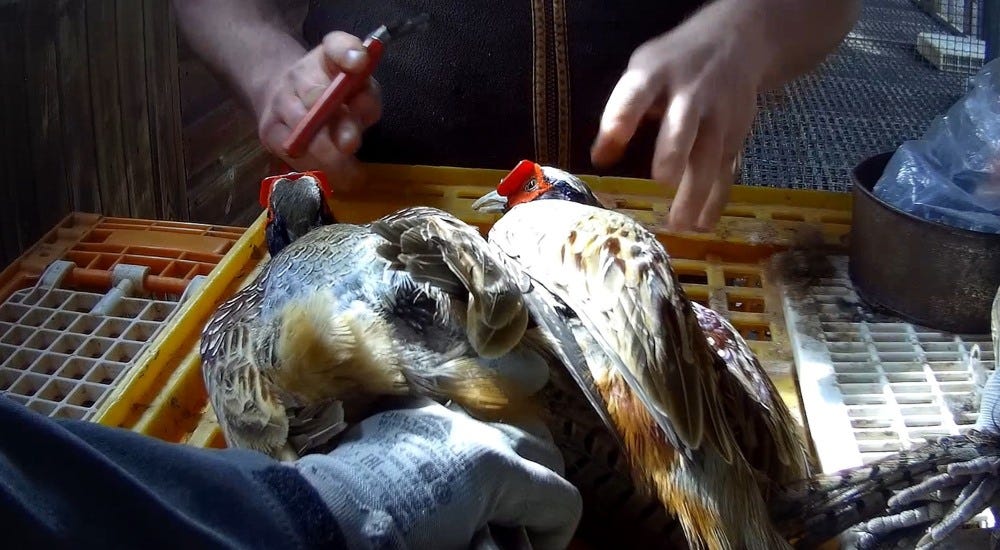
The industry’s solution is to blunt the weapon rather than address the conditions that make birds want to use it.
The beak guard, the spectacles to stop a bird being able to see forward, is the industry’s answer to a problem IT HAS CREATED by removing the one thing that makes pheasant aggression manageable: space.
And every moment of stress during the fitting procedure - every bird grabbed, inverted, pinned and processed - is additional and unjustified stress that exists because of a commercial decision to take a species shaped by open landscape and confine it.
The terror inflicted on pheasants through the routine fitting of plastic beak guards is not the act of a few bad actors though - it is a systemic cruelty in which every tier of the shooting industry bears responsibility.
Breeders, producers like Heart of England Ltd, have normalised the practice to the point where fitting restraints to every bird’s face - regardless of whether individual animals had shown any aggressive behaviour - has simply become part of the production process.
The breeder is the factory floor of the shooting world, churning out traumatised animals at scale, but the estates that purchase these birds are not passive recipients. Estates are the willing market that makes the economics of that cruelty viable, buying creatures whose distress has already been baked in and releasing them into further stress for ‘sport’.
And then there is the client: the hobbyist who pays to stand in the field, raises the barrel, and asks no questions. Their money is the engine of the entire system. To purchase a day’s shooting is to commission, at every stage of the supply chain, the suffering of animals who were restrained, mutilated and terrified long before the first shot was fired.
Technically Lawful, Entirely Telling
As a final point, it is important to be precise about what the law currently says and does not say.
The law doesn’t give pheasants and partridges specific protection - they are supposedly covered by the Animal Welfare Act, but in reality live in a grey area where the industry makes the rules and decides what is or isn’t acceptable.
The fitting of beak guards to pheasants, even routinely, does not currently constitute a criminal offence.
The shooting industry has been careful to operate in the gap between its own voluntary codes - which suggest beak guards should be a last resort - and the harder edges of the law. Heart of England Ltd, as far as can be established, is not breaking any statute.
But because something is currently ‘legal’ that doesn’t make it morally or ethically ‘acceptable’. The question we should be asking is not whether a prosecution could be brought, but why is any of this allowed in the first place?
The fact is that it is only ‘allowed’ because some people want to shoot birds and politicians have done nothing to stop them.
In no way at all can wanting to blast birds out of the sky for fun justify factory farming, poor handling, putting birds under severe stress, and forcing them to live in barren cages with plastic or metal attached to their beaks until they are caught up again and the guards and spectacles pulled off before being sold to shoots.
But this is how the industry works - and it has no intention of changing.
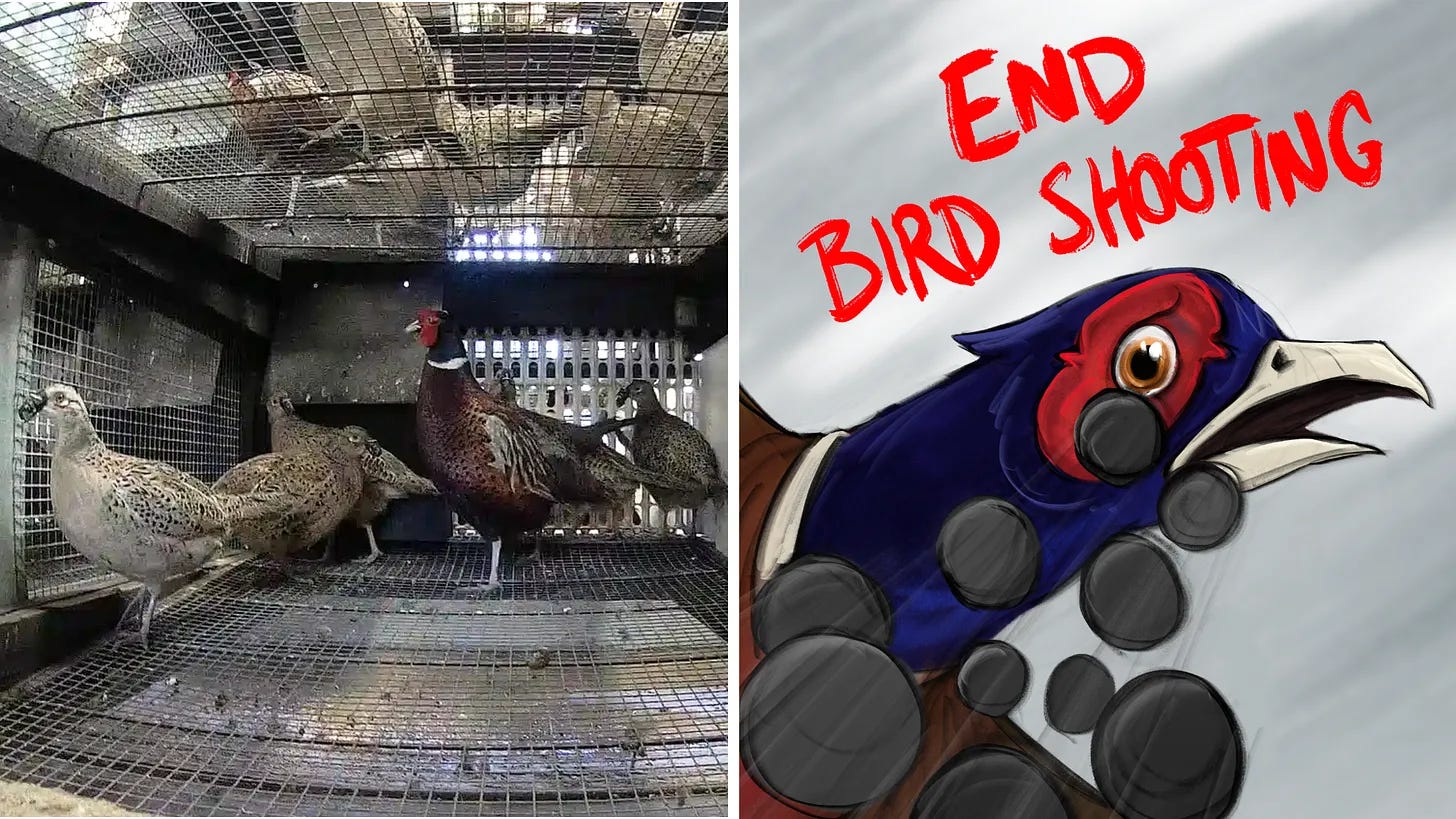
There is no ‘better version’ of this. Which is why we are working to END BIRD SHOOTING rather than just reform it.
Images and video recorded by our undercover investigator at Heart of England in 2025.
We are working to END BIRD SHOOTING. This suffering has to stop. Please share this article. Share our socials. Follow us for updates.
Join the movement. Become a Game Changer.
We are at the beginning of something. Months of undercover work. Hundreds of hours of footage. Farms across the UK exposed. And we are only just getting started.
But investigations alone do not end industries. People do.
We are asking you to become a Game Changer. To stand with us as we take this fight forward, week by week, piece by piece, until the public, the media and the politicians can no longer look away. The first 500 people to sign up will receive a limited edition pin badge.
This is the beginning. Be part of it.
So the evil f@@ks aren't satisfied with blasting and maiming the birds in the sky...they have also found ways to make them suffer beforehand. What is wrong with them?
They don't care about the suffering