
Tiny, Terrified and Treated Like Products: Inside a Pheasant Hatchery

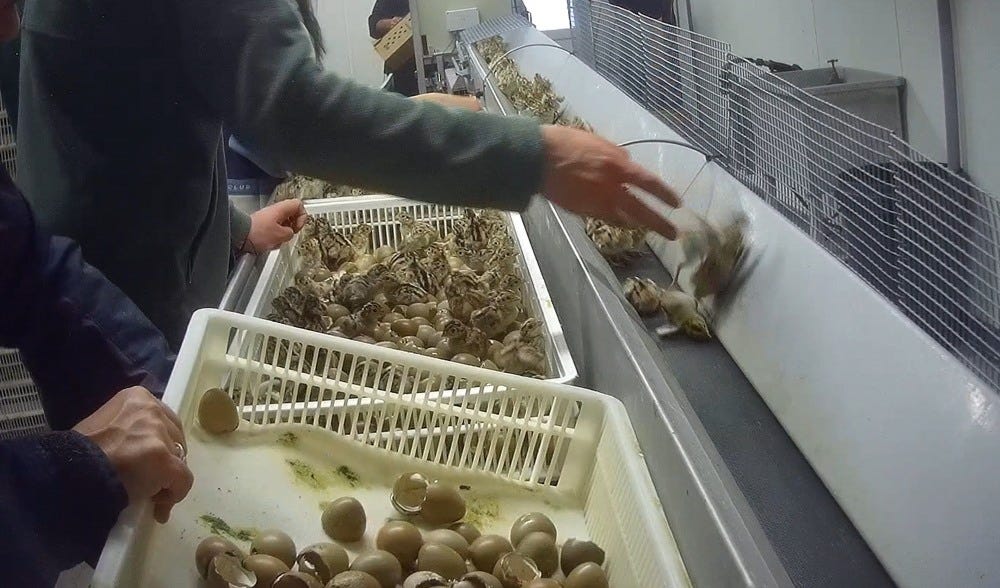
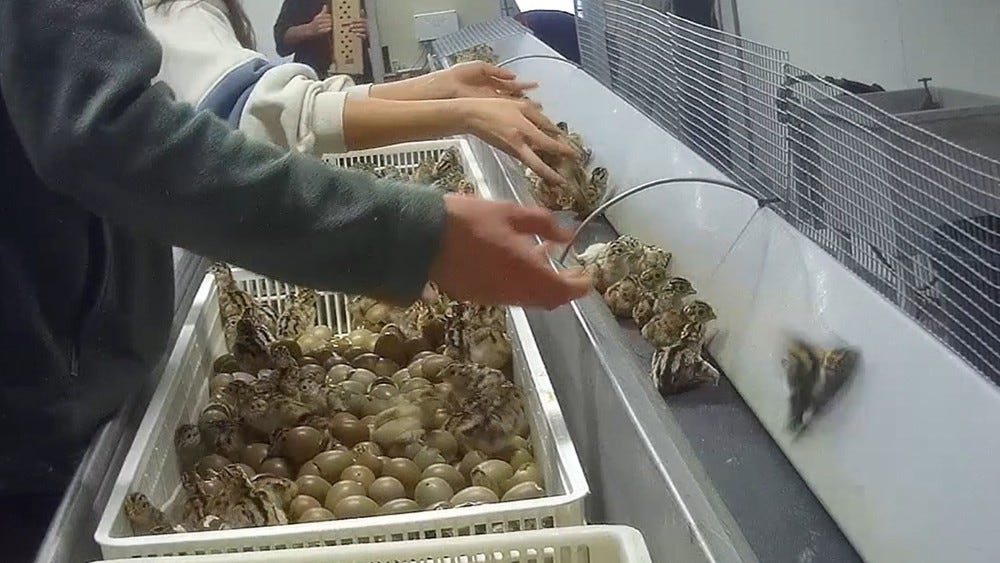
Over the past few months we have been publishing analysis of undercover footage obtained on so-called ‘game farms’ across England. We began by looking at the sheer scale of the shooting industry, then how adult birds (not every bird, but far too many) are sometimes treated, and the enormous numbers of eggs collected and washed - and in some cases dumped unlawfully in open-air trailers. We’re now going to look at what happens to the chicks the industry breeds for the gun…
On a so-called ‘game farm’ a pheasant chick’s first hours in the world are spent in darkness, huddled for warmth beneath the red glow of a brooder lamp. At this stage, a pheasant chick is about as fragile as a living creature can be.
And yet within days, that same chick is pulled from the dark and carried into a different world entirely - a factory floor loud with people and machinery, bright with strip lighting, where this tiny animal is handled, sexed, and dropped onto a moving metal conveyor belt alongside thousands of other chicks.
It is a jarring transition for any young animal, let alone one this delicate: from stillness to noise, from shelter to exposure and the mechanical efficiency of an industrial sorting line. Ground-nesting and precocial birds like pheasants are born with an instinct to see large, fast-moving silhouettes as potential threats; however, on the factory line there is no mother to guide or comfort, and no experience to interpret the shock of this enormous change. Yet this is where the story of the “game” pheasant really begins - not in some scenic, unspoiled woodland, but on a production line built for volume, speed, and profit.
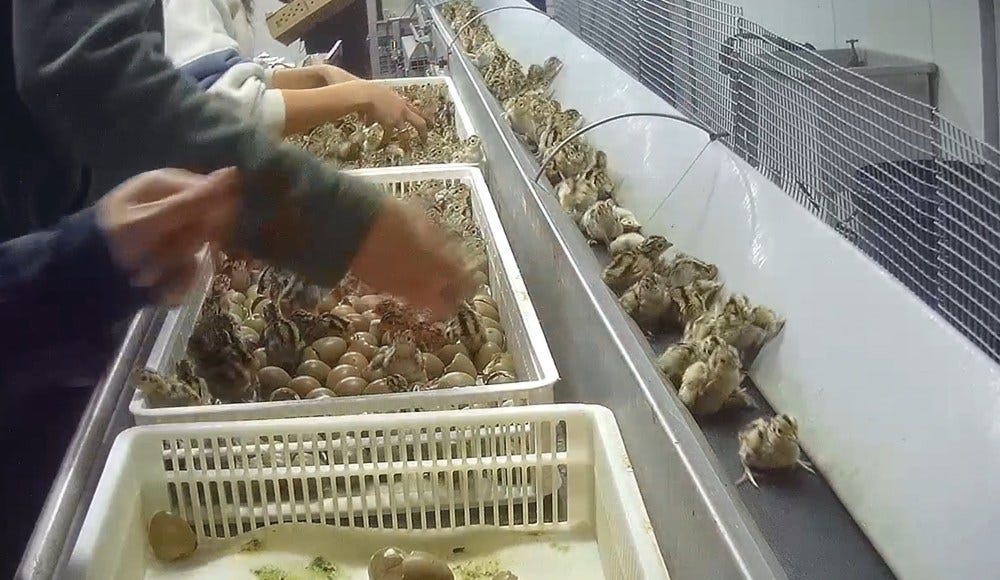
Looking at the images and video in this post we think it is clear that to the workers standing at that belt, hour after hour, thousands of birds a day, the chick is just one more item to be sorted, moved, processed. But a chick is not a package at a fulfilment centre. A chick is not a vegetable being checked for blemishes. This is a very young animal, small enough to fit in a cupped palm, their bones still soft.
What the rules actually say
A chick is an animal that, by the industry’s own guidelines, is supposed to be handled with a level of care that this footage simply does not show.
The UK government’s Code of Practice for the Welfare of Gamebirds Reared for Sporting Purposes (in other words, how birds reared to be used as live targets ought to be treated) exists precisely because hatchery and rearing work happens at a pace and scale where birds can easily be forgotten as individuals.
The code is explicit that management practices must not be compromised by the speed of operation, and that birds must be handled by competent, experienced people in a way that avoids injury.
The RSPCA’s own welfare standards for hatcheries go further, stating plainly that birds must be handled carefully and compassionately at all times, that care must be taken to prevent injury during handling, and that manual handling should be kept to an absolute minimum.
These are not vague aspirations. They are specific, written acknowledgements that day-old chicks are fragile enough to be hurt by rough handling - bruised, crushed, or injured by falls that would mean nothing to an inert object like a carrot but everything to a body this small.
Watch the belt again with that in mind. Each bird weighs perhaps 30 to 40 grams. Bones have not hardened. Legs are not yet reliably load-bearing. A chick has no way to brace for a fall, no way to signal distress that a worker moving at speed has time to notice.
When a chick is carried along by a machine built to move inert material efficiently, ‘it’ is being treated exactly as the machine was designed for - as a unit, a product, not as a live animal that can suffer.
This isn’t really about ‘bad workers’ - it’s about a ‘bad industry’
It would be easy, and wrong, to make this article about cruel individuals though. What the footage shows looks far more like the consequence of industrial scale: workers processing thousands of eggs and chicks a day, on a line moving at a pace set by production targets they did not choose, doing a repetitive task until the animals in front of them stop registering as animals at all.
Even when one of those tiny and vulnerable chicks is trapped between two trays, in danger of being dragged under and crushed by the spinning rollers…
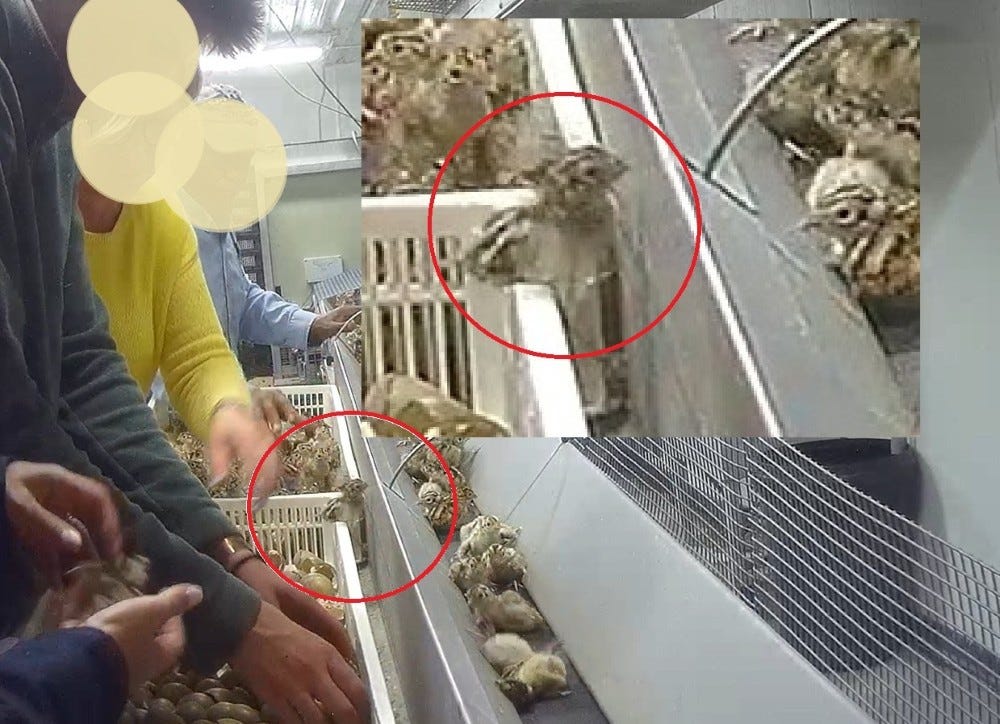
Psychologists call this a kind of perceptual numbing - when a task is repeated often enough and fast enough, the brain stops processing each instance individually. A chick becomes a unit, not an individual. That is not malice. It is a coping mechanism. It is what industrial-scale processing of living creatures does to the people doing it, and it is exactly why welfare codes insist on limits regardless of how anyone happens to feel in the moment.
That is also why the responsibility for what this footage shows lies not with the person standing at the belt, but with the system that put them there - one that sets throughput targets which make the code’s language about care and minimal handling almost impossible to honour in practice.
One that, by treating chicks as an inert commodity teaches everyone who works within it to see them the same way.
Will anyone be prosecuted?
We’re often asked whether we could prosecute based on the evidence we have, and in this case the honest answer is: probably not. Causing an animal unnecessary suffering is a criminal offence in this country, but courts have historically reserved that finding for conduct that is unambiguous: visible injury, obvious distress, sustained mistreatment.
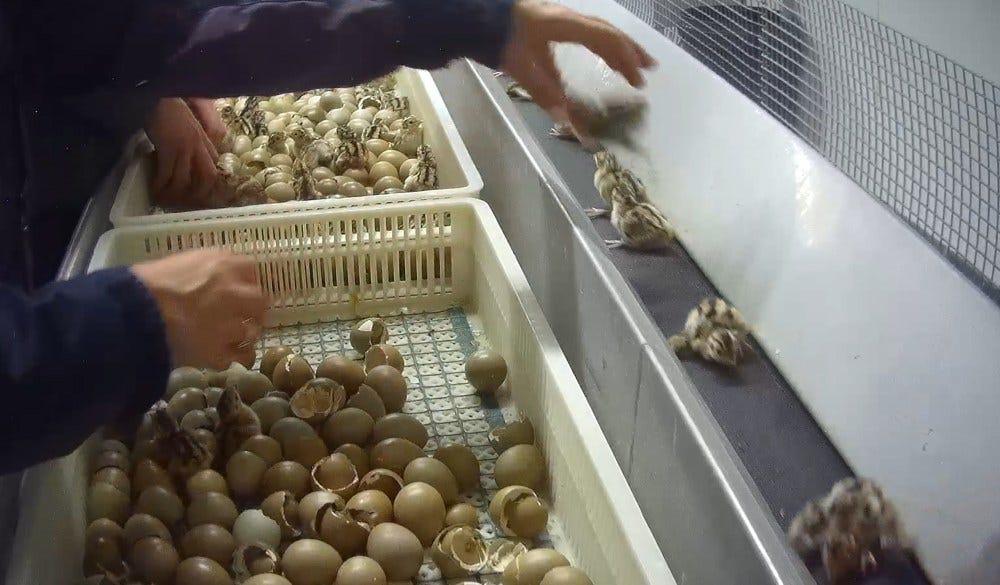
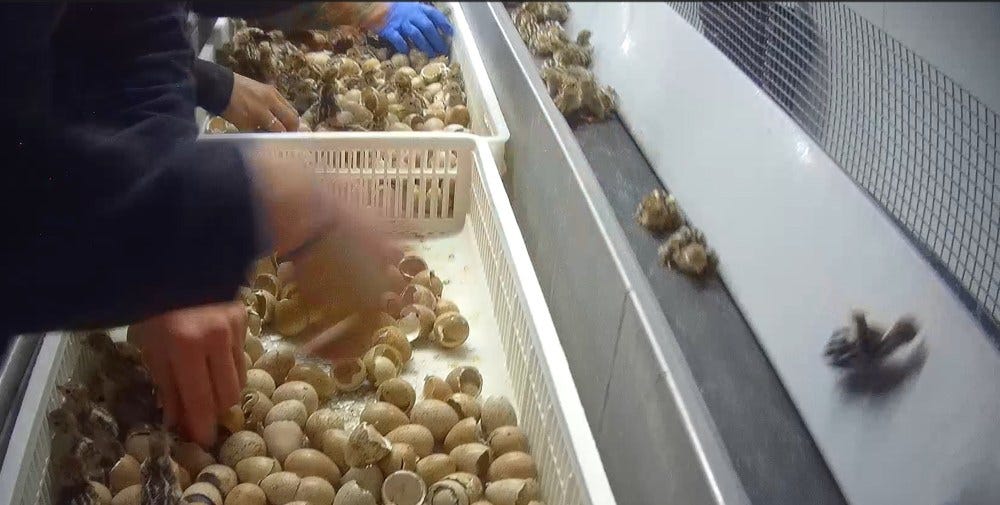
A chick tumbling a short distance onto a moving belt among other chicks, without a clear injury on camera, is unlikely to meet that threshold on its own, however hard it is to watch.
What footage like this does show, though, is something a criminal charge was never going to capture anyway: the physical set-up and pace of work of an industry-standard ‘sorting’ system sits uneasily beside the very code of practice the industry says it follows - a code that requires chicks to be handled with care and that manual handling be kept to a minimum.
We don’t know, and can’t claim to know, whether the staff on that belt had received sufficient training to meet those standards. Our footage covered a short window, and the undercover worker didn’t have an opportunity to speak to everyone. The farm would undoubtedly claim that they provide sufficient training anyway.
What the footage does show, though, is what actually happened in that window, regardless of what training was given: the gap between a published guide to careful handling and what a moving belt actually does to a tiny and vulnerable bird passing along it.
It is, if anything, a harder thing to explain than a criminal case would be, because there is no dispute to have about it: the code exists, and the footage (and we have plenty more of it) speaks for itself.
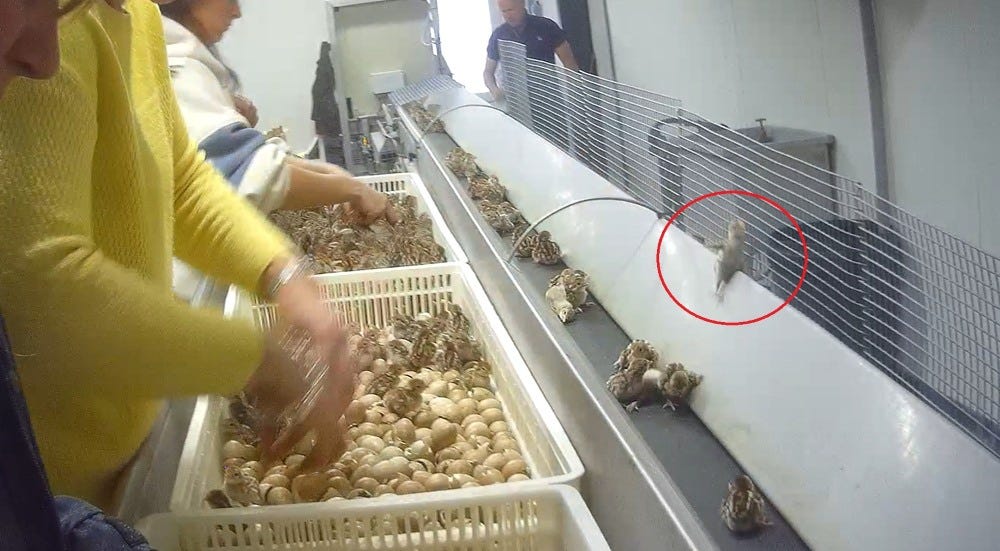
A small moment, a larger question
Millions of pheasant chicks pass through hatcheries like this one every year, destined for release onto shooting estates as live targets, to be shot for so-called “sport.” The belt wasn’t designed to be cruel. It was built to be fast and efficient.
But a hatchery is not a factory sorting non-sentient fruit or vegetables, whatever the equipment suggests - and even the short clip in this post shows exactly how easily that distinction disappears when speed and volume matter more than the animal moving through the system.
We are routinely challenged about why we aim to shut down this vile industry. Look at the screenshots and the footage again. These are the first fragile hours of a bird’s life. The rest of that life will be as short and brutal.
How anyone can support any of this is absolutely beyond us…
Next in this series: Why are the chicks being sexed anyway? Because males don’t lay eggs…
Video and images recorded by our undercover investigator in 2025.
We are working to END BIRD SHOOTING. This suffering has to stop. Please share this article. Share our socials. Follow us for updates.
End Bird Shooting
Over the coming months our campaign will look at the shooting industry at every level. We will highlight the suppliers — the farms, hatcheries, importers and breeders producing tens of millions of birds under conditions that would provoke public outcry if applied to any other animal. We will expose the providers — the estates and syndicates that take those factory-farmed birds and sell the experience of killing them as leisure. And we will look at the clients — the paying guns who are fully aware of the wildlife crime, the trapping of native predators, and the mass suffering involved, and who have decided that none of it is reason enough to stay away.
This industry survives because suppliers supply, providers provide, and clients pay. We intend to examine them all.
Join the movement. Become a Game Changer.
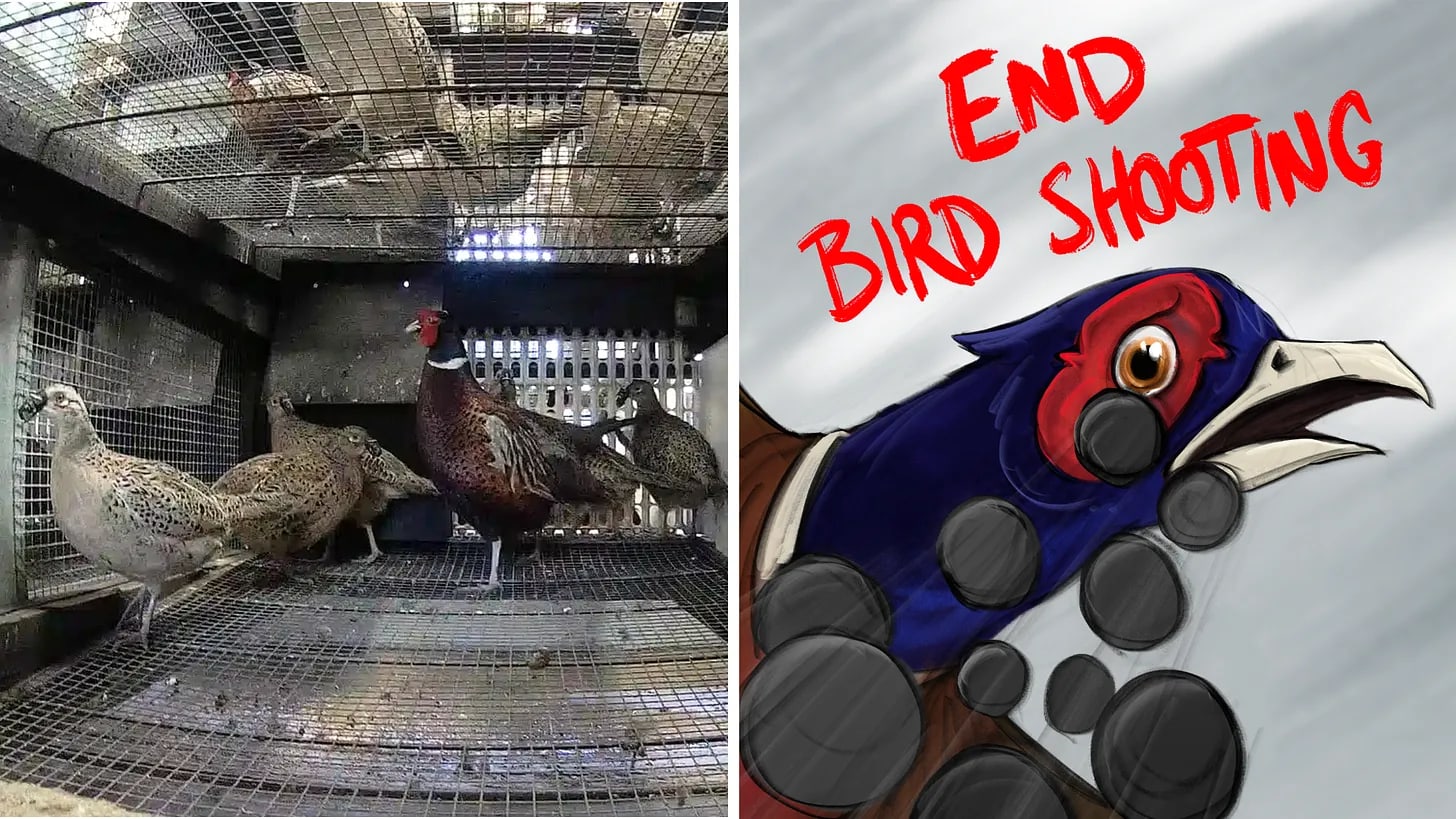
We are at the beginning of something. Months of undercover work. Hundreds of hours of footage. Farms across the UK exposed. And we are only just getting started.
But investigations alone do not end industries. People do.
We are asking you to become a Game Changer. To stand with us as we take this fight forward, week by week, piece by piece, until the public, the media and the politicians can no longer look away.
This is the beginning. Be part of it.
Read this twice and im furious really angry, these are innocent babies being treated like their lives dont matter maybe a word with the rspca to make un planned visits to see this horror might lead to prosecutions of the treatment these little chaps are facing as for being numbed to this like you say these people arent numbed their callous nobody treats babies like this pure evil the sooner its stopped the better
Thank you for exposing and reporting on this painful cruel system that only views profit.